
Recommendations Aim to Fill Impending Vacancies; Include Transfer of Meghalaya Chief Justice to Kerala
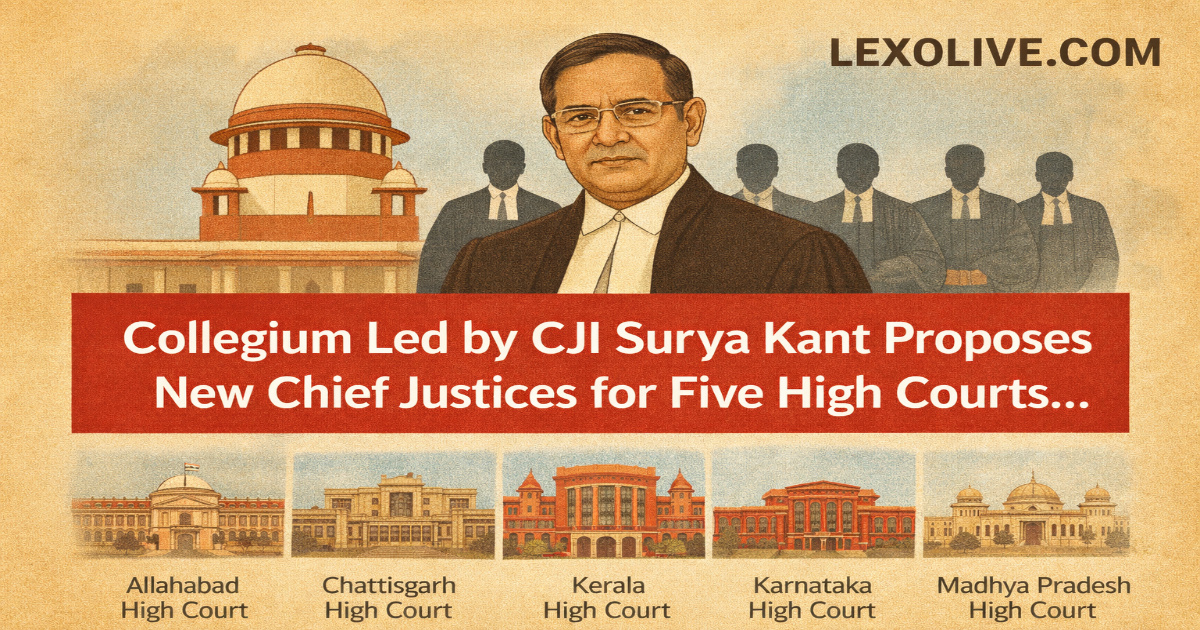
In a significant administrative move marking the beginning of a new tenure, the Supreme Court Collegium under the leadership of Chief Justice of India Surya Kant has proposed a comprehensive reshuffle in the leadership of five High Courts across India. The recommendations, finalized on December 18th, aim to fill imminent vacancies and strategically reposition judicial expertise, setting the tone for the collegium’s approach under its new helm.
This first set of proposals from Justice Surya Kant’s collegium underscores a proactive stance in addressing the perennial challenge of vacancies in the higher judiciary. By anticipating retirements scheduled for early 2026 and orchestrating a key transfer, the collegium has demonstrated an intent to ensure continuity and stability in the administration of justice.
The Recommended Appointments: A Closer Look
The collegium’s recommendations spotlight a diverse group of judges, each with distinguished careers, poised to take on the administrative and judicial responsibilities of a Chief Justice.
- For Uttarakhand High Court: Justice Manoj Kumar Gupta of the Allahabad High Court has been nominated to succeed Chief Justice Guhanathan Narendar upon his retirement on January 9, 2026. Justice Gupta, known for his erudite and balanced judgments, brings a wealth of experience from one of the country’s largest High Courts. His appointment is expected to guide the relatively younger Uttarakhand High Court, which often deals with significant matters pertaining to environmental law, pilgrimage governance, and land rights in the Himalayan region.
- For Meghalaya High Court: In a move that creates a cascade, the collegium has recommended Justice Revati P. Mohite Dere of the Bombay High Court for the role of Chief Justice in Meghalaya. This recommendation follows the proposed transfer of the incumbent, Justice Soumen Sen. Justice Mohite Dere, with a robust background in criminal law, is recognized for her meticulous and principled stance on legal procedure. Her leadership could be pivotal for the Meghalaya High Court, which serves a unique socio-legal landscape in the Northeast.
- For Jharkhand High Court: Justice M.S. Sonak, also from the Bombay High Court, has been proposed as the next Chief Justice of Jharkhand, succeeding Chief Justice Tarlok Singh Chauhan who retires on January 8, 2026. Justice Sonak has built a reputation for his expertise in constitutional, service, and environmental matters. His acumen will be crucial for the Jharkhand High Court, a jurisdiction grappling with complex issues related to mineral rights, tribal welfare, and industrial regulation.
- For Sikkim High Court: The collegium has tapped Justice A. Muhamed Mustaque from the Kerala High Court for elevation as Chief Justice of Sikkim. Justice Mustaque is widely respected for his progressive and thoughtful jurisprudence, particularly in areas of civil rights and social justice. His appointment to Sikkim, India’s smallest High Court with a unique blend of local and national legal issues, marks a significant step in his judicial career.
- For Patna High Court: Justice Sangam Kumar Sahoo of the Orissa High Court has been recommended for the top post in Patna. This elevation places him at the helm of one of the oldest and busiest High Courts. Justice Sahoo’s experience in Orissa, a state with its own share of administrative and developmental challenges, is likely to inform his leadership in Bihar, where the judiciary faces a massive caseload and issues ranging from governance to infrastructure.
The Strategic Transfer: Justice Soumen Sen to Kerala
Beyond fresh elevations, the collegium has orchestrated a significant inter-High Court transfer. It has recommended that Justice Soumen Sen, currently Chief Justice of Meghalaya, be transferred to take charge as the Chief Justice of the Kerala High Court. This move is in anticipation of the retirement of Kerala’s present Chief Justice, Nitin Jamdar, on January 9, 2026.
Justice Sen’s transfer is particularly noteworthy. He was at the center of a notable judicial episode in January 2024. The Supreme Court had taken suo motu cognizance of strong comments made by a single judge of the Calcutta High Court, Justice Abhijit Gangopadhyay, who had termed an order by a division bench led by Justice Sen as “illegal and ignored.”
The case pertained to alleged irregularities in West Bengal’s MBBS admissions. This incident highlighted internal tensions within a High Court. Justice Sen was subsequently transferred from Calcutta to Meghalaya in October 2025. The collegium’s current recommendation to place him at the helm of the prestigious Kerala High Court is a move that will be closely watched, potentially seen as a fresh assignment following the earlier corrective transfer.
Context and Implications
These recommendations represent more than just routine appointments. They are the first under CJI Surya Kant, offering an early glimpse into the collegium’s priorities—speed in filling vacancies, geographical diversity in appointments, and strategic use of transfers for institutional management.
The collegium system, whereby the senior-most judges of the Supreme Court recommend appointments and transfers, has often been subject to public debate regarding transparency and efficiency. This swift action by the new collegium, coming early in Justice Surya Kant’s tenure, may be interpreted as an effort to address criticism of delays. By acting on vacancies announced well over a year in advance, the collegium provides the Union Government ample time for the mandatory background checks and final processing, aiming for a seamless transition.
The recommendations now await the approval of the Union Government. While the government can seek clarifications or reiteration, established precedent mandates that the collegium’s final opinion holds primacy. Assuming timely approval, these judges will step into their new roles, bringing their distinct judicial philosophies and administrative styles to courts that serve millions of citizens.
The leadership of a High Court Chief Justice is instrumental in setting the tone for case management, judicial innovation, and administrative reform. As these judges prepare to assume their new responsibilities, their appointments will undoubtedly shape the judicial landscape of their respective states, influencing the course of justice in matters both monumental and mundane. This reshuffle, therefore, is not merely an administrative exercise but a foundational step in steering the Indian judiciary through the challenges and opportunities of the coming years.
Read more:-


One thought on “Collegium Led by CJI Surya Kant Proposes New Chief Justices for Five High Courts”