
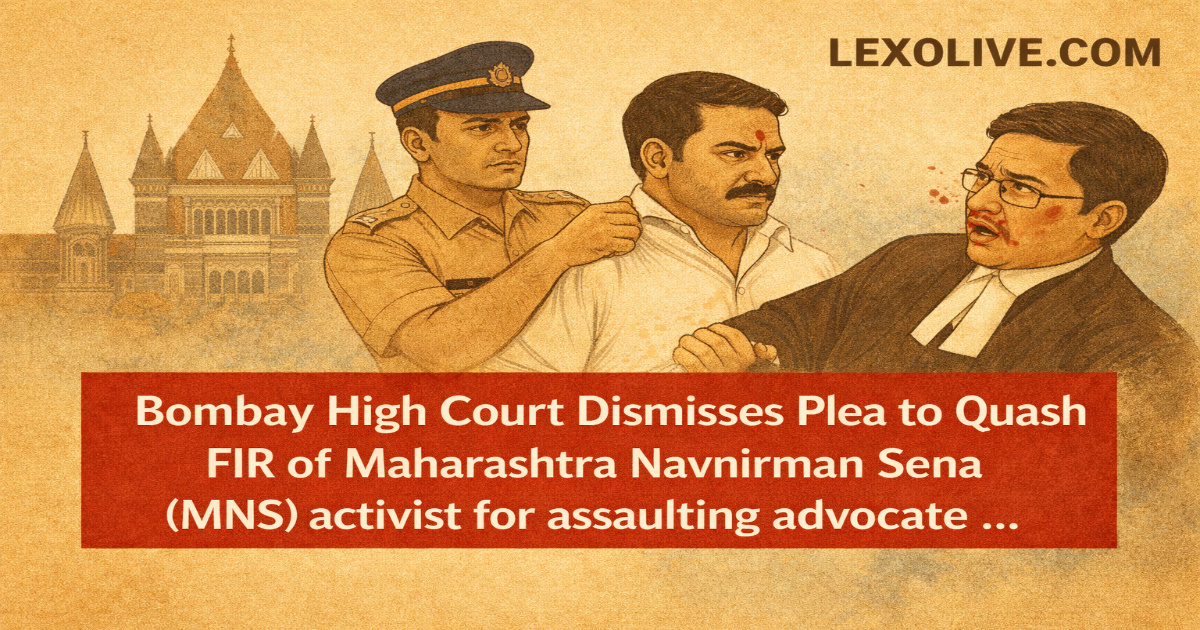
Bombay High Court Dismisses Plea to Quash FIR, Emphasizes Trial Court’s Role in Assessing Evidence
Mumbai, December 9, 2025: The Bombay High Court, in a significant ruling, has dismissed a criminal writ petition seeking the quashing of a First Information Report (FIR) related to the alleged assault of an advocate, underscoring the limitations of its inherent powers when a prima facie case exists and investigation is complete. The bench of Justices Ranjitsinha Raja Bhonsale and A.S. Gadkari declined to interfere, directing the petitioner to avail the alternative remedy of filing a discharge application before the competent trial court.
The Case at a Glance
The petition was filed by Akhil Anil Chitre, seeking to quash an FIR (No. 884/2020) registered at Mumbai’s Dindoshi Police Station on December 4, 2020. The FIR, lodged by advocate Durgesh Ramchandra Gupta (Respondent No. 2), alleged offences under Sections 341 (wrongful restraint), 323 (voluntarily causing hurt), 504 (intentional insult with intent to provoke breach of peace), 506 (criminal intimidation), and 34 (common intention) of the Indian Penal Code.
The genesis of the dispute lay in a civil suit filed by Amazon Transportation Pvt. Ltd. against activists of the Maharashtra Navnirman Sena (MNS), including the petitioner. The company had sought an injunction to prevent them from entering its premises over demands to use Marathi language in operations. The City Civil Court at Dindoshi had granted an ex-parte stay on October 22, 2020.
The complainant, Advocate Gupta, represented the company in court on December 4, 2020, as the original advocate was unwell. According to the FIR, after the hearing concluded around 1:30 PM, an unknown person accosted Gupta, asking if he was responsible for the stay order. Subsequently, two others allegedly assaulted him. The complainant claimed that while the assailants fled, he spotted the petitioner, Akhil Chitre, removing his car from the scene. The FIR alleged that Chitre, along with three unknown persons, acting with common intention, wrongfully restrained, assaulted, and abused the complainant.
Petitioner’s Arguments and State’s Rebuttal
Chitre’s counsel, Advocate Tapan Thattet, argued vehemently for quashing the FIR. He contended that the FIR itself assigned no direct role to Chitre in the assault and failed to disclose any cognizable offence against him. He asserted that statements recorded later during the investigation could not be used to supplement a deficient FIR to invoke cognizable offences.
The State, represented by Acting Public Prosecutor Smt. M. M. Deshmukh and APP Mr. Vinod Chate, presented a starkly different picture. They informed the Bombay High Court that the investigation was complete and a chargesheet was ready to be filed. The state submitted that:
- Witness statements, including those of fellow advocates present at the spot, implicated the petitioner.
- CCTV footage existed showing the petitioner trying to flee the scene in his car.
- The complainant had sustained injuries in the assault.
- The petitioner was a “history-sheeter,” with several other offences registered against him at various police stations in Mumbai.
Court’s Reasoning and Legal Grounding
After hearing both sides, the Bombay High Court meticulously analyzed the legal position. The bench observed that based on the FIR, investigation papers, statements, and the injury certificate, it could not be concluded that “no case at all is made out.” On the contrary, the court found a prima facie case clearly established against the accused, including the petitioner.
The judgment extensively relied on recent Supreme Court precedents that narrowly define the scope of quashing powers under Section 482 of the Code of Criminal Procedure (CrPC) or Article 226 of the Constitution.
- Iqbal alias Bala Vs. State of U.P. (2023): The Supreme Court, in a case where the FIR lacked specific details like date and time, still declined to quash it because the investigation was complete and a chargesheet was ready. The Apex Court had directed the appellants to prefer a discharge application under Section 227 CrPC before the trial court, which would be the proper forum to examine the collected evidence.
- Central Bureau of Investigation Vs. Aryan Singh (2023) & Manik B. Vs. Kadapala Sreyes Reddy (2023): These rulings were cited to reiterate that the High Court cannot conduct a “mini-trial” or appreciate evidence at the quashing stage. The power is to be exercised only if, taking the prosecution case at its face value, no offence is made out. The court cannot scrutinize the correctness of the material in the chargesheet.
The bench pointed out that the petitioner’s arguments essentially constituted his defence—claiming non-participation and questioning witness statements. The Bombay High Court held that such defences must be tested through evidence during a trial, not in a quashing petition. “What the Petitioner raises before us is his defence, which can only be tested or tried at the trial,” the judgment stated.
Ruling and Refusal of Interim Relief
Consequently, the Bombay High Court dismissed the writ petition. It emphasized that where an equally efficacious alternative remedy exists—like a discharge application before the trial court—a constitutional writ petition or a petition under Section 482 CrPC is not the appropriate first step. The purpose of Section 482 is to prevent abuse of process, not to bypass established legal procedures.
At the conclusion of the hearing, the petitioner’s counsel requested a four-week extension of the interim relief (likely protection from arrest) that had been in place since 2021, to allow time for an appeal to the Supreme Court. The bench, however, declined this request. Considering the reasoning in the judgment, the four-year pendency of the petition, and the need for the investigation to reach its logical conclusion, the court stated it was “not inclined to extend the interim relief.”
Broader Implications
This Bombay High Court judgment reinforces a consistent judicial trend discouraging the use of quashing petitions as a shortcut to derail the criminal process after investigation is complete. It reaffirms the trial court’s primacy in evaluating the merits of evidence collected by the prosecution. For accused individuals, the message is clear: once a chargesheet is filed, the battleground shifts to the trial court, where arguments on the sufficiency of evidence must be raised through appropriate applications like those for discharge. The Bombay High Court’s decision underscores the principle that constitutional and inherent powers are extraordinary remedies, not substitutes for the due process of trial.
For the Petitioner- Advocate Tapan Thatte
For the Respondent-State (State of Maharashtra): Smt. M. M. Deshmukh & Mr. Vinod Chate
Read more:-
Collegium Led by CJI Surya Kant Proposes New Chief Justices for Five High Courts
2 thoughts on “Bombay High Court Dismisses Plea to Quash FIR of Maharashtra Navnirman Sena (MNS)activist for assaulting advocate”