

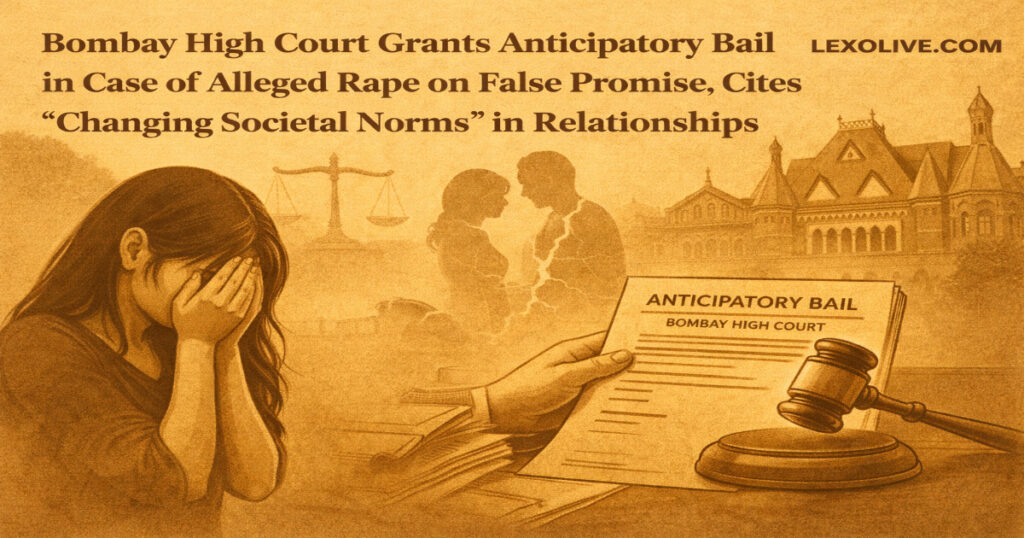
Justice Milind Jadhav of Bombay High Court Observes “Non-Committal Consensual Relationship Turning Sour” in Matter Involving Seven-Year Relationship; Imposes Strict Electronic Device Surrender Condition
In an order that scrutinizes the evolving nature of adult relationships and the application of rape laws in cases of alleged breach of promise to marry, the Bombay High Court on Friday granted anticipatory bail to a Thane resident accused of rape, causing miscarriage, and assault. Justice Milind N. Jadhav, while allowing the application, made prima facie observations that a prolonged, seemingly consensual relationship between two adults could not be easily classified as rape merely because it eventually soured.
The case, which has sparked discussion on legal boundaries in personal relationships, involves applicant and a complainant who was separated, but not divorced, from her husband.
The Allegations: A Seven-Year Saga with a Serious Turn
The prosecution’s case, as presented by Additional Public Prosecutor Mr. Hitendra Dedhia, was grave. According to the FIR (C.R. No. 824 of 2024 registered at Vishnu Nagar Police Station, Thane), the complainant, a woman living with her minor daughter since separating from her husband in 2014, met Kankekar in November 2017. The applicant, nine years her junior, allegedly professed his love and promised marriage.
It was alleged that from 2017 to 2024, Kankekar repeatedly forced a physical relationship on the complainant despite her stated wish to abstain until marriage. The accusations included taking her to a guest house in January 2018, tying a “fake mangalsutra,” and taking obscene photographs. Critically, the FIR alleged he forced her to terminate pregnancies in 2021 and 2022. The trigger for filing the police complaint in September 2024 was the applicant’s alleged expression of a desire to establish a physical relationship with the complainant’s minor daughter, which made her doubt his intentions entirely.
The Defense: A “Frivolous” FIR from a Sour Relationship
Arguing for the bail applicant, Advocate Ms. Bhagyesha Kurane painted a starkly different picture. She contended the FIR was “frivolous” and stemmed from a consensual love affair that had turned acrimonious. She highlighted that both parties were aware marriage was legally impossible since the complainant was only separated, not divorced. The continuation of a physical relationship until as recently as March 2024, without complaint, was cited as proof of consent.
Ms. Kurane argued that the seven-year delay in reporting the initial allegations undermined the prosecution’s case of lack of consent. Regarding the abortions, she presented medical reports to suggest the complainant had consented to the procedures. She accused the complainant of approaching the court with “unclean hands” for suppressing the subsisting marriage in her FIR.
The State’s Counter: Hope, Deception, and a Sinister Turn
APP Mr. Dedhia countered that the complainant’s silence for years was borne out of hope that the applicant would marry her once her divorce was finalized. He submitted that her divorce proceedings had ultimately been dismissed, prolonging the uncertain situation. He emphasized that the applicant’s alleged advance towards her minor daughter was the moment the “sinister intentions” became clear, revealing the promise of marriage as a mere “ploy to exploit her.”
Mr. Dedhia stressed the seriousness of the charges under Sections 376 (rape), 313 (causing miscarriage without consent), 323 (voluntarily causing hurt), and 504 (intentional insult) of the IPC, and argued the applicant posed a risk to the complainant and her daughter.
The Bombay High Court’s Analysis: Scrutinizing Consent in a Modern Context
After examining the records and arguments, Justice Jadhav focused his analysis on the specific allegations against the applicant concerning the complainant, noting the charges did not currently extend to acts concerning the minor daughter.
On the Charge of Rape (Section 376 IPC): The Bombay High Court delved deeply into the concept of consent based on a false promise to marry. Justice Jadhav noted both parties were major, above 30, and had engaged in a relationship for nearly seven years, involving regular visits, monthly trips to a guest house, and frequent communication. “In such circumstances,” he observed, “the likelihood of a non-committal consensual relationship later turning sour cannot be ruled out prima facie.”
He relied heavily on the precedent set in Mahesh Balkrishna Dandane Vs. State of Maharashtra (2014), where the court had acknowledged changing societal norms. Justice Jadhav quoted the observation: “Nowadays keeping sexual relationship while having an affair or before marriage is not shocking as it was earlier… The Court cannot be oblivious to a fact of changing behavioural norms and patterns between man and woman relationship in the Society.”
The Bombay High Court judgment distinguished between cases where a woman is induced due to class disparity or fraud (like hiding a first marriage) and cases of relationships between educated adults that eventually break down. “Every breach of promise to marry cannot be said to be either a cheating or rape,” the cited ruling stated.
On the Charge of Causing Miscarriage (Section 313 IPC): The Bombay High Court found it prima facie suspect that the complainant had consented to the medical terminations in 2021 and 2022 but only raised it as a forceful act in 2024, alongside other allegations. The “unreasonable” silence and the “tagging” of this allegation with others solidified the court’s doubt, suggesting it might be a case of “recrimination” after a souring relationship.
On Other Charges: The Bombay High Court found no material on record to form an opinion that offences of hurt (323) or intentional insult (504) were committed.
The Bail Order and Stringent Conditions
Balancing the prima facie doubts with the seriousness of the allegations, Justice Jadhav of Bombay High Court granted anticipatory bail but imposed strict conditions:
- Release on a Personal Recognizance Bond of ₹25,000 with one or two sureties.
- A prohibition on tampering with evidence or influencing the complainant or witnesses.
- Monthly attendance at the police station.
- Mandatory surrender of his mobile phone and laptop to the investigating officer by January 18, 2025—a condition reflecting the digital nature of modern evidence and allegations.
- Regular updates of residence and contact details to the court and police.
The Bombay High Court explicitly clarified that its observations were prima facie and confined to the bail application, and the trial court must decide the case on its own merits, uninfluenced by this order.
Broader Implications: Law Interpreting Life
This Bombay High Court ruling underscores the judiciary’s ongoing struggle to apply centuries-old penal laws to the complexities of modern interpersonal relationships. It highlights the legal test for “rape on the false promise of marriage,” which requires proving not just a broken promise, but that the promise was made in bad faith from the inception with the sole intention of securing sexual favours.
By referencing “changing behavioural norms” and “ground realities,” the order calls for a nuanced, case-by-case analysis over a “straightjacket formula.” It serves as a reminder that while the law must protect victims of sexual deception, it must also guard against the weaponization of serious criminal provisions in disputes arising from failed relationships between aware, consenting adults. The investigation in the case will now proceed with the applicant shielded from arrest, bound by the stringent conditions designed to ensure its integrity.
- For the Applicant– Ms. Bhagyesha Kurane, Advocate.
- For the Respondent – State: Mr. Hitendra Dedhia, Additional Public Prosecutor (APP).
Read more:-
One thought on “Bombay High Court Grants Anticipatory Bail in Case of Alleged Rape on False Promise, Cites “Changing Societal Norms” in Relationships”