
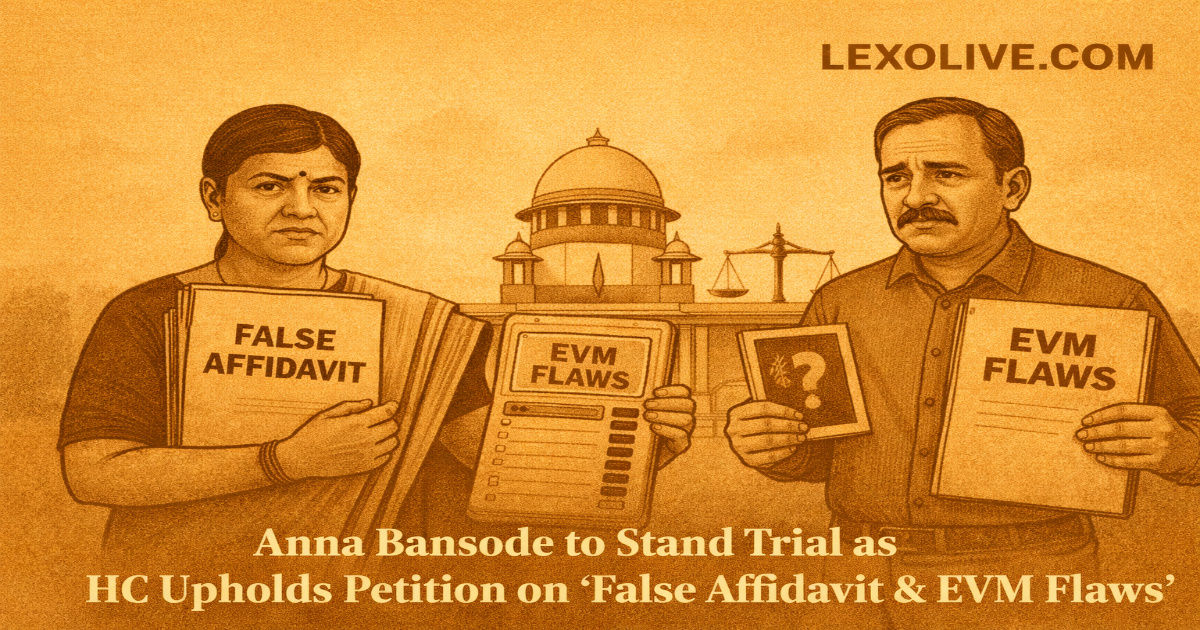
Bombay High Court orders full hearing into allegations of false affidavit and EVM irregularities, rejecting Anna Bansode’s plea for summary dismissal.
Mumbai, November 20, 2025 – The Bombay High Court has delivered a detailed judgment refusing to summarily dismiss an election petition against Anna Bansode, the elected MLA from the 206-Pimpri (SC) Assembly Constituency. Justice Gauri Godse, in a reasoned 31-page order, held that the petition filed by defeated candidate Sulakshana Raju Dhar disclosed a valid cause of action and must proceed to a full trial.
The ruling came in response to an application (No. 24466 of 2025) filed by Anna Bansode under Order VII Rule 11 of the Code of Civil Procedure, seeking rejection of the election petition at the threshold for alleged vagueness, lack of material facts, and defective verification.
Background: The Disputed Election
The petition challenges the outcome of the Maharashtra Legislative Assembly election held on November 20, 2024, in which Anna Bansode was declared elected on November 23, 2024. Sulakshana Dhar, who secured 72,575 votes—the second-highest tally—contested the result on multiple grounds, primarily under Sections 100(1)(d)(i) and (iv) of the Representation of the People Act, 1951.
Her allegations are twofold:
- False Affidavit and Nomination Issues: Dhar alleged that Anna Bansode filed a false affidavit (Form 26) by concealing his joint ownership of agricultural land (Gat No. 1593) and omitting his spouse’s financial liabilities that were disclosed in his affidavits for the 2009, 2014, and 2019 elections.
- EVM-VVPAT Irregularities: The petition claimed serious procedural violations in the conduct of the election, including the use of EVM machines with detachable sticker-based serial numbers instead of permanently engraved identification marks, non-compliance with the Election Commission’s own guidelines and SOPs, and failure to properly enroll young voters (aged 18–19).
The Legal Battle: Threshold Arguments
Anna Bansode’s Contentions for Summary Dismissal:
Arguing for the elected candidate, Advocate Tejas Deshmukh contended that the petition was fundamentally flawed and deserved to be “rejected at the threshold.” His core submissions were:
- Lack of Material Facts: The petition was “bereft of material facts” and contained only vague, bald allegations without the necessary particulars required under Section 83 of the R.P. Act. He argued that simply attaching 7/12 land extracts did not prove ownership, as Anna Bansode was listed only as an office-bearer of a society that owned the land.
- Defective Verification: The verification clause of the petition did not comply with Section 83(1)(c) of the Act and Order VI Rule 15 CPC. Deshmukh argued that Dhar could not possibly have personal knowledge of all allegations (like past affidavits or EVM manufacturing details) and failed to disclose her sources of information.
- Reliance on Precedents: He cited a line of Supreme Court judgments to stress the strict, statutory nature of election jurisdiction. In Jyoti Basu v. Debi Ghosal, the SC held that an election petition is a purely statutory proceeding where common law principles do not apply. In Hari Shanker Jain v. Sonia Gandhi and Karim Uddin Barbhuiya v. Aminul Haque Laskar, the apex court ruled that petitions based on vague allegations lacking material particulars must be dismissed at the outset.
- No Cause of Action: Deshmukh concluded that the petition failed to disclose any meaningful cause of action as contemplated under the law and was an attempt to conduct a “fishing inquiry.”
Dhar’s Defense for Proceeding to Trial:
Opposing the application, Advocate Sneha Bhange for Sulakshana Dhar argued that the petition clearly disclosed triable issues. Her key defenses included:
- Material Facts Sufficiently Pleaded: Bhange asserted that all “material facts” – the primary facts constituting the cause of action – had been clearly stated. She distinguished between “material facts” (which must be pleaded) and “particulars” (which are details to be proved through evidence at trial).
- Documents and Specifics Provided: The petitioner had annexed relevant documents: 7/12 extracts, copies of objections filed with the Returning Officer, email correspondence, and the rejection letter for her RTI application seeking Form 17-C and video recordings. This, she argued, provided ample specifics.
- Verification Based on Personal Knowledge: Bhange explained that the allegations were based on Dhar’s own observations and campaigning experience. Since she was a candidate who personally filed objections and witnessed the process, verification based on personal knowledge was appropriate.
- Supporting Precedents: She relied on Virender Nath Gautam v. Satpal Singh, where the SC explained the distinction between “material facts” and “particulars,” and Ashraf Kokkur v. K.V. Abdul Khader, which emphasized that a petition should not be dismissed if it contains the basic pleadings necessary to pose a triable issue.
Court’s Analysis and Key Findings
Justice Godse undertook a meticulous examination of the pleadings and the cited case law. Her analysis formed the crux of the rejection of Anna Bansode’s application:
- Distinction Between “Material Facts” and “Particulars” is Paramount: The Court heavily relied on the Supreme Court’s explanation in Virender Nath Gautam. It reiterated that “material facts are primary or basic facts which must be pleaded,” while “particulars are details in support of material facts… which ensure conduct of a fair trial.” The Court held that Dhar had pleaded the necessary material facts—the what, when, and where of the alleged irregularities. The finer details (the “how”) could be adduced as evidence during the trial.
- Petition Discloses Cause of Action for Specific Grounds: Justice Godse found that while the petition did not properly make out a case of “corrupt practice” under Section 100(1)(b), it did sufficiently plead grounds under Section 100(1)(d)(i) and (iv). These cover improper acceptance of a nomination and non-compliance with the provisions of the Constitution or the R.P. Act. The allegations regarding the false affidavit (touching on nomination validity) and the EVM procedural violations fell squarely within these grounds.
- Verification and Personal Knowledge Upheld: The Court accepted Dhar’s explanation that her verification was based on personal knowledge gained as an active participant in the election process. “In view of the nature of the allegations… there would be no question of disclosing the source of personal knowledge,” the judge observed.
- Defense Cannot Be Considered at This Stage: Justice Godse categorically stated that while examining a plea for rejection under Order VII Rule 11, the court cannot consider the respondent’s possible defense. Anna Bansode’s explanation about the land records being in the name of a society was deemed a “matter of trial,” not a reason to shut down the petition.
- Trial Necessary for Evidence and Proof: The Court repeatedly emphasized that the threshold for dismissal is high. “Whether or not the election petitioner can prove the said allegations is a matter of evidence, which can be considered only at the stage of trial.” The petition, by annexing documents and making specific claims about EVM stickers and missing voter names, had crossed the minimum bar to proceed.
Conclusion and Implications
Dismissing Anna Bansode’s application, Justice Godse concluded: “By no stretch of imagination can it be said that the material fact… has not been stated in the petition for rejecting the petition at the threshold. The cause of action has been disclosed. Therefore, the petition cannot be rejected at the threshold.”
What Happens Next:
The court’s ruling now propels Election Petition No. 18 of 2025 into the trial phase, where Anna Bansode, as the respondent, will be required to participate in the discovery process. Both sides will exchange lists of witnesses and documents before presenting evidence in court. The trial will focus intently on examining documentary and technical evidence—particularly concerning EVM procedures and affidavit disclosures—with Anna Bansode’s alleged irregularities placed under formal judicial scrutiny.
This ruling is a significant setback for the sitting MLA Anna Bansode and reinforces the principle that election disputes raising substantive legal and factual questions must be thoroughly examined in a trial, ensuring that electoral grievances are not dismissed on mere technical or procedural grounds at the preliminary stage.
For the Applicant / Original Respondent No. 1 (Anna Bansode)
- Mr. Tejas Deshmukh
Instructed by: Mayur Govind Sanap and Mikhil Chate
For the Respondent / Original Petitioner (Sulakshana Raju Dhar)
- Ms. Sneha Bhange
Along with: Mr. Swapnil L. Sangle and Ms. Divya Verma
For Respondent Nos. 3 to 5 (Election Authorities)
- Ms. Naira Jeejebhoy
Along with: Mr. Arun Panickar, Mr. Vinay Nair, and Mr. Tanmay Pawar
Read more:-
One thought on “Anna Bansode to Stand Trial as HC Upholds Petition on “False Affidavit & EVM Flaws””