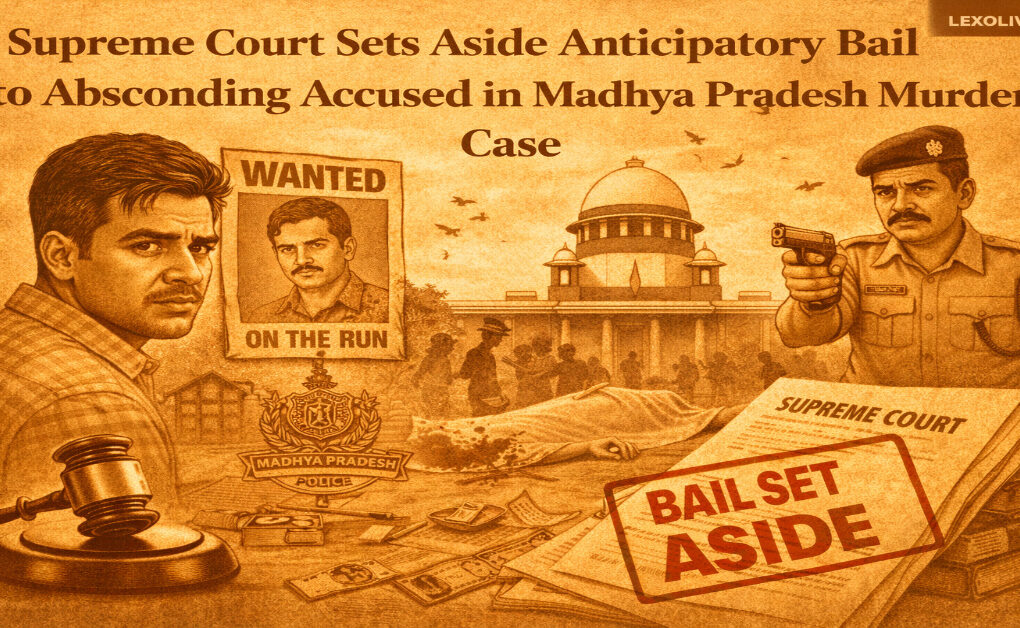
New Delhi, February 23, 2026: In a significant judgment reinforcing the principles governing anticipatory bail, the Supreme Court today set aside the order of the Madhya Pradesh High Court granting pre-arrest bail to an accused who had been absconding for over six years in a murder case. The bench held that a person who evades the process of law cannot claim the relief of anticipatory bail as a matter of right, and the subsequent acquittal of co-accused does not automatically entitle an absconding accused to parity.
A bench of Justices J.B. Pardiwala and Vijay Bishnoi allowed the appeal filed by the original complainant, Balmukund Singh Gautam, challenging the High Court's order dated January 19, 2024. The impugned order had disposed of the third anticipatory bail application filed by the accused, Chandan Singh, directing him to surrender before the trial court and move a regular bail application, with further direction that the trial court shall grant bail on the same day after imposing adequate conditions.
Case Background: Political Rivalry Turns Fatal. The case originates from incidents that occurred on June 2, 2017, stemming from purported political rivalry between two groups, leading to the registration of three separate FIRs. According to the allegations, the complainant and his companions were wrongfully restrained near a petrol pump on Pithampur Road by the named accused, who stopped the complainant's car, attacked them, and damaged the vehicle with stones, sticks, swords, and gunfire. One Bablu Chaudhary later succumbed to his injuries, whereupon Section 302 IPC was added. A cross FIR was also registered by co-accused Chandan Singh against nine persons including the original complainant.
The Accused's Conduct: Absconding for Six Years. A critical factor that weighed heavily against the accused was his conduct throughout the investigation — he had been absconding since the date of the incident. Rewards of Rs.10,000 and Rs.15,000 were declared for his arrest. While absconding, he allegedly threatened the main eyewitness, leading to a separate FIR against him.
Trial Developments. The trial in both the subject FIR and cross FIR concluded on June 24, 2023, when the Additional Sessions Judge, Indore, acquitted all named accused in the subject FIR other than the absconding accused, holding that the prosecution had failed to prove the deceased was hit by bullets fired by the named accused. In the cross FIR, the trial court convicted the original complainant and five others under Section 307 read with 149 IPC. Relying on this acquittal, the accused preferred his third anticipatory bail application, which the High Court disposed of by directing him to surrender and move regular bail, to be granted the same day.
Supreme Court's Analysis. Setting aside the High Court's order, the bench referred to landmark judgments including Shri Gurbaksh Singh Sibbia v. State of Punjab and the Constitution Bench decision in Sushila Aggarwal v. State (NCT of Delhi), reiterating the factors relevant to anticipatory bail: prima facie ground to believe the accused committed the offence, gravity of accusation, danger of absconding, likelihood of tampering with evidence, and criminal antecedents.
On absconding accused, the Court held that an absconder is not entitled to anticipatory bail as a general rule. “Granting anticipatory bail to an absconding accused sets a bad precedent and sends a message that law-abiding co-accused who stood trial were wrong to diligently attend the process of law, and incentivizes people to evade the process with impunity,” the bench observed.
On parity with acquitted co-accused, the Court categorically rejected the argument that acquittal of co-accused entitles an absconding accused to anticipatory bail on ground of parity, since the prosecution is not required to adduce evidence against an absconding accused in the first place. “The accused cannot be permitted to encash on the acquittal of the co-accused persons,” the court held, also taking serious note of his criminal antecedents and the unrecovered firearms used in the incident.
The Final Direction. The Supreme Court set aside the impugned order and directed the accused to surrender before the concerned court within four weeks, clarifying that he would thereafter be free to seek regular bail, to be decided in accordance with law without being prejudiced by this judgment. The court also expressed surprise that the State of Madhya Pradesh had not filed any appeal challenging the High Court's order despite supporting the complainant's case.