
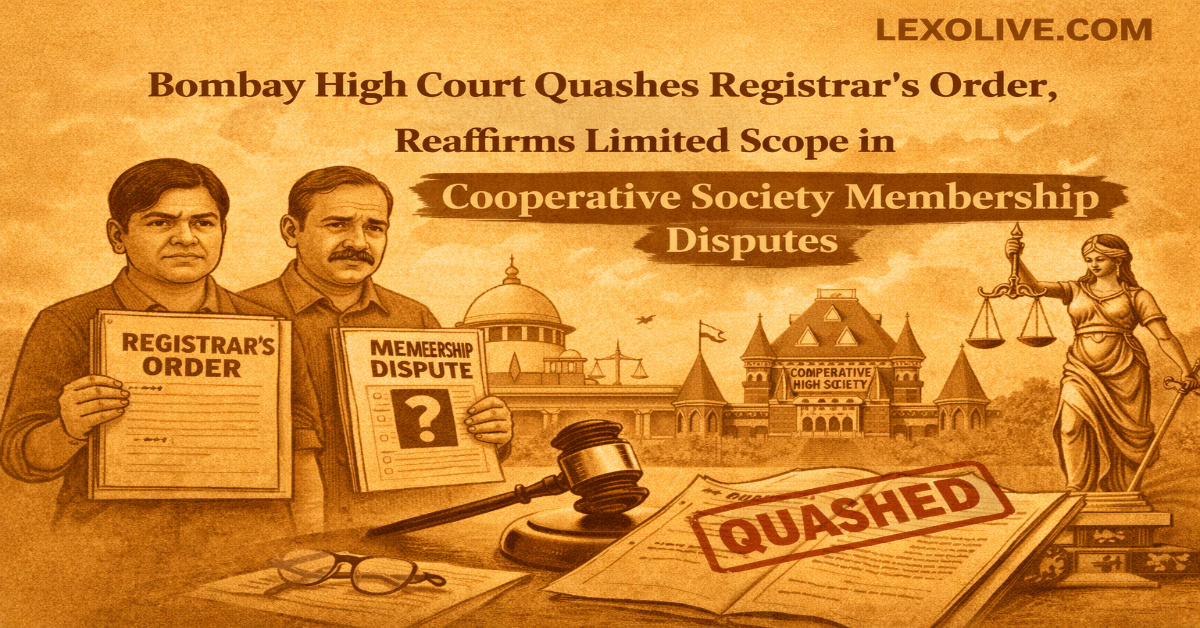
In a significant ruling, the Bombay High Court has set aside an order by a divisional joint registrar, criticizing the authority for overstepping its jurisdiction by venturing into complex questions of succession and inheritance matters that fall strictly within the purview of civil courts.
MUMBAI: In a judgment that clarifies the limits of quasi-judicial authorities under the Maharashtra Co-operative Societies Act, 1960, the Bombay High Court has underscored that such bodies are not empowered to adjudicate disputes related to inheritance or the validity of succession documents. The Bombay High Court’s observation came while quashing a revisional authority’s decision that had denied membership to a man in a Peddar Road cooperative housing society based on alleged discrepancies in a nomination form.
Justice Amit Borkar, presiding over the single bench of Bombay High Court, delivered the order on February 9, emphasizing that the role of the cooperative department is strictly confined to regulating membership as per the Act and the society’s byelaws. It cannot assume the functions of a civil court by delving into title disputes or the genuineness of succession claims.
The Genesis of the Dispute
The case revolves around a flat and garage located in Alpana CHSL on Peddar Road. The property was originally allotted to one Pravinkumar Dave’s father. In 1974, the senior Dave formally nominated his son, who was a minor at the time, for membership in the society. The flat, however, was tenanted out to a company. A year after making this nomination, Pravinkumar’s father passed away, leaving behind a family of ten legal heirs and no last will or testament.
Decades later, in 2002, Pravinkumar Dave formally approached the housing society, requesting that his name be entered as a member based on the 1974 nomination made by his late father. When the society failed to act on his application, he was left with no recourse but to approach the cooperative department.
Initial Relief and Subsequent Reversal
In February 2006, the Deputy Registrar (D ward) ruled in favor of Dave. After reviewing the facts, the Deputy Registrar directed the society to confer membership upon him. This order was expected to resolve the long-pending issue. However, the decision was challenged in revision before the Divisional Joint Registrar, the appellate authority within the cooperative framework.
The challenge was mounted not only by the housing society but also by a third party claiming tenancy rights over the flat. The revisional authority took a stance that led to the current legal battle. It scrutinized the original 1974 nomination form and found what it described as “overwriting.” Deeming the document unreliable, the Divisional Joint Registrar set aside the Deputy Registrar’s order. The authority reasoned that in the absence of an “unimpeachable and undisputed” nomination document, Dave could not be granted membership, thereby implying a dispute over the validity of the nomination itself.
The Heirs’ Stand and Legal Representation
Aggrieved by this reversal, Dave approached the Bombay High Court through his advocate, Satyavijay Vaishnav. During the proceedings, Vaishnav brought a crucial fact to the court’s attention: the dynamics within the Dave family. Out of the ten legal heirs of the original member, a significant majority had no objection to Pravinkumar Dave becoming a member. Specifically, six of the heirs had issued formal No-Objection Certificates (NOCs) in his favor. One of the ten had predeceased the father, and two others chose not to raise any objection to the claim. The court was informed that only a single legal heir had come forward to oppose Dave’s nomination. Furthermore, it was argued that the society itself had not disputed Dave’s eligibility under its own byelaws or the provisions of the Cooperative Societies Act.
High Court’s Observations: The Core Legal Principles
Justice Borkar, after hearing the arguments, framed the primary legal question: Could a cooperative authority deny membership based on a perceived flaw in a nomination document when the majority of legal heirs supported the claim, and the society had no objection to the applicant’s eligibility?
Citing settled legal principles, the court referred to a landmark 2016 judgment by the Supreme Court of India. The apex court had clearly delineated the role of a nominee. It held that nomination does not confer ownership or absolute title on the nominee. Instead, its purpose is functional and administrative: it empowers the society to deal with a specific, identified individual regarding the share or interest of a deceased member. This mechanism ensures that the society has a clear point of contact for managing its records and affairs, but it does not settle the ultimate ownership of the property, which is determined by succession laws.
Applying this principle to the case at hand, Justice Borkar noted that since Pravinkumar Dave’s father died intestate (without a will), his interest in the flat and the society membership devolved upon all his Class I legal heirs under the Hindu Succession Act. In such a scenario, the membership rights flow to the entire body of legal representatives.
The judge observed that the record clearly demonstrated that a “majority of the heirs” supported Dave’s claim to membership. The internal family arrangement, where most heirs consented to Dave representing the family’s interest in the society, was a private matter that the cooperative authorities should respect, not obstruct.
The Question of Locus Standi
Perhaps the most critical aspect of the judgment was the court’s ruling on who has the right to challenge such orders. Justice Borkar pointed out a key procedural flaw: the order granting membership was not challenged by the one dissenting legal heir. Instead, it was contested by the housing society and a third party claiming tenancy.
The court firmly rejected the tenant’s right to intervene in such a dispute. “A tenant has no locus standi to question the internal arrangement among legal heirs regarding membership of the society,” Justice Borkar stated unequivocally. A tenant’s rights, if any, are limited to occupation and are subordinate to the rights of the landlord and the society. Allowing a tenant to dictate or challenge the internal succession and membership decisions of the legal heirs would be a gross overreach.
Regarding the society’s challenge, the court noted that the society had not raised any valid objection under its byelaws or the Act regarding Dave’s eligibility. Its primary grievance appeared to be linked to the tenancy issue, which was irrelevant to the question of membership succession.
Conclusion: Overreach by Revisional Authority
Concluding his judgment, Justice Borkar of Bombay High Court held that the Divisional Joint Registrar had grossly exceeded its jurisdiction. By focusing on the “overwriting” in a 32-year-old document and deeming it not “unimpeachable,” the revisional authority had engaged in an exercise that resembled a civil trial—examining the authenticity of documents and deciding succession rights.
“The authority under the Maharashtra Co-operative Societies Act is concerned with the regulation of membership, and it is not a civil court deciding succession disputes,” Justice Borkar reiterated. “Therefore, the revisional authority exceeded its jurisdiction in setting aside the order of conferment of membership on grounds which fall outside the limited scope of such proceedings.”
The High Court quashed and set aside the order of the Divisional Joint Registrar, effectively restoring the Deputy Registrar’s 2006 directive that granted Pravinkumar Dave membership in the Alpana CHSL. The ruling serves as a strong precedent reinforcing that cooperative authorities must operate within their defined statutory boundaries and cannot interfere in family succession matters, especially when a majority of the legal heirs are in consensus.
Read more:-

One thought on “Bombay High Court Quashes Registrar’s Order, Reaffirms Limited Scope in Cooperative Society Membership Disputes”