
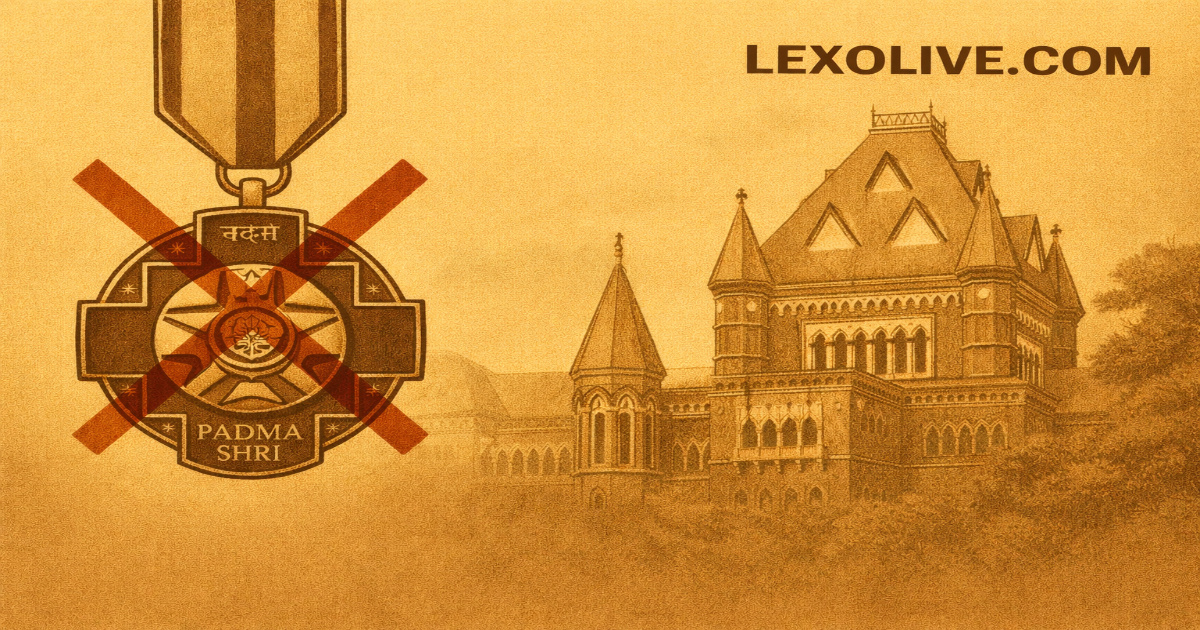
The Bombay High Court Upholds a Precedent: Affirming Awards as Honours, Not Titles, The Bombay High Court Corrects a Record: Striking Down the “Padma Shri” Prefix.
A recent judicial pronouncement from the Bombay High Court has served as a powerful reminder of the constitutional spirit embedded within India’s highest civilian honours. During a routine hearing, Justice Somasekhar Sundaresan took objection not to the core arguments of the case, but to the manner in which one of the parties was named in the official records. The case title read “Dr. Trimbak V. Dapkekar versus Padmashree Dr. Sharad M Hardikar & Ors,” a formulation that led the bench to issue a corrective directive.
This incident, seemingly minor, reopened a fundamental question about the nature of awards like the Padma Shri, Padma Bhushan, Padma Vibhushan, and the Bharat Ratna: are they titles, or are they something else entirely? The Bombay High Court’s firm reiteration that they are unequivocally not titles carries deep legal, historical, and societal significance.
The Judicial Directive and Its Constitutional Anchoring
Justice Sundaresan’s bench did not base its objection on personal preference but on settled constitutional law. The Court invoked a definitive 1995 judgment by a five-judge Constitution Bench of the Supreme Court of India. That Bombay High Court landmark ruling had explicitly clarified that these national honours “do not confer any title” and, therefore, cannot be used as prefixes or suffixes to an individual’s name. By citing this precedent, the Bombay High Court underscored the binding nature of the Supreme Court’s authority under Article 141 of the Constitution, which mandates that the law declared by the apex court is binding on all courts within India.
The Bombay High Court’s intervention was procedural yet profound. It directed the removal of the “Padma Shri” prefix from the case records, affirming that such usage is “legally impermissible.” This action reinforces a critical principle: in the eyes of the law, an awardee’s legal identity remains unchanged by the reception of the honour. The award is a recognition of past distinguished service, not an alteration of personal status that warrants a change in formal nomenclature within legal or official documents. This ensures uniformity, accuracy, and a separation between state-conferred recognition and an individual’s inherent legal persona.
Historical Context: Rejecting the Legacy of Titles
To fully appreciate this legal stance, one must understand the historical context from which it emerged. The Indian Republic, born from a struggle against colonial rule and its entrenched hierarchies, consciously moved to dismantle systems of hereditary privilege and titular adornment. The constitutional framers embedded this ethos in Article 18, which abolishes titles, with a specific exception made for military and academic distinctions. The Padma Awards system, instituted in 1954, was designed to be a modern, egalitarian form of recognition, celebrating individual achievement without creating a new class of nobility.
The Supreme Court’s 1995 judgment was the definitive interpretation of this constitutional vision. It settled any ambiguity, declaring that the Bharat Ratna and Padma Awards are not titles under Article 18. They are, instead, symbols of national appreciation for exceptional contributions. Allowing them to be used as prefixes would risk creating a subtle class of “title-holders,” contrary to the egalitarian ideals of the Constitution. The Bombay High Court’s recent order is a vigilant enforcement of this decades-old principle, preventing any dilution or casual misuse that could accumulate over time.
The Deeper Implications: Recognition vs. Entitlement
The Bombay High Court ruling underscores a philosophical distinction bettween recognition and entitlement. A title often implies a permanent, often hereditary, elevation in social standing and can become a tool for perpetuating distinction. An award, in the Indian constitutional scheme, is a singular act of honouring specific deeds and contributions. It does not come with ongoing social prefix or legal privilege. The moment “Padma Shri” transforms from an award one received to a title one uses, its character changes from a celebratory acknowledgement to a permanent marker of differential identity.
This has practical implications for the awardees themselves and for society. For the recipients, the honour lies in the achievement itself and the ceremonial conferment. Using it as a prefix could, ironically, diminish the dignity of the award by reducing it to a tool for self-aggrandizement or social climbing. For society, maintaining this boundary prevents the formal stratification of citizens and reinforces the idea that respect is earned through actions, not appended through labels. It keeps the focus on the work that merited the award, not on a perpetual honorific.
Global Practice and the Importance of Adherence
India’s position is consistent with practices in many other democratic republics. For instance, in the United Kingdom, while knights and dames use the honorific “Sir” or “Dame,” state awards like the Order of the British Empire are typically denoted by post-nominal letters (e.g., “OBE,” “MBE”), not prefixes. In India, the deliberate choice to avoid even post-nominal letters for the Padma awards (though sometimes unofficially used) underscores a stricter adherence to the anti-title principle.
The only permissible exceptions, as noted, are well-defined academic qualifications (like Dr.) or military ranks, which denote an office, profession, or earned qualification, not a state-bestowed honour for broad service.
Conclusion: Preserving the Sanctity of the Honour
The Bombay High Court’s observation, though made “purely as an incidental point,” is a significant act of judicial stewardship. It protects the integrity of both the awards and the constitutional framework that created them. By checking the casual use of “Padmashree” as a prefix in a legal document, the court performed a gatekeeping role. It reminded all institutions—legal, media, and the public—of the correct and respectful way to acknowledge these honours.
The Padma Awards and the Bharat Ratna represent the nation’s highest gratitude to its citizens. Their value lies in their exclusivity, their symbolic weight, and their connection to the republic’s core values. To treat them as mere titles to be prefixed before names is to misunderstand their essence and undermine the constitutional philosophy they embody.
This Bombay High Court judicial reminder ensures that these awards remain what they were intended to be: prestigious recognitions of excellence that inspire others, not instruments that create a separate class of citizens. Their glory is in their meaning, not in their grammatical placement before a name. Upholding this distinction is key to preserving the sanctity of the honour itself and the egalitarian ideals of the nation that confers it.
Read more:-
Justice Over Bureaucracy: Bombay HC Orders ₹50 Lakh for COVID Hero’s Family

Courts have time for every nonsense but not to expedite justice delivery system. Simply playing ding dong.