
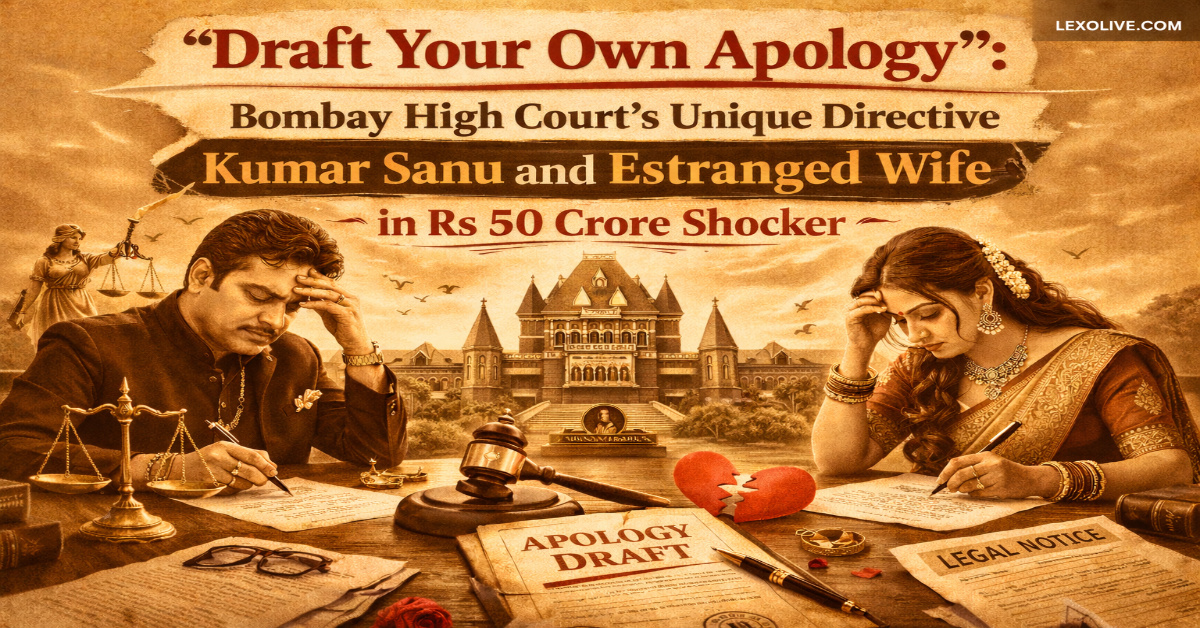
In a rare judicial intervention, the Bombay High Court has ordered veteran playback singer Kumar Sanu and his former wife, Rita Bhattacharya, to sit together and pen the text of a public apology, offering a potential escape route from a bitter defamation battle that has gripped the entertainment industry.
Mumbai, February 19, 2026: In an extraordinary turn of events that blends high-stakes litigation with human drama, the Bombay High Court on Wednesday took the unusual step of directing estranged couple Kumar Sanu and Rita Bhattacharya to collaboratively draft the language of a public apology. The directive, issued by a single bench of Justice Milind Jadhav, is aimed at defusing a ticking legal bomb that involves a staggering Rs 50 crore defamation claim.
The Bombay High Court’s unique order—essentially asking the warring parties to become co-authors of a peace offering—comes after Bhattacharya’s legal counsel communicated her willingness to issue an apology to the “Aashiq Banaya Aapne” singer. In a significant quid pro quo, Sanu’s legal team responded by indicating that a public mea culpa, circulated through the media, would be sufficient grounds for their client to consider withdrawing the defamation suit filed in December of last year.
However, the Bombay High Court was careful to frame this exercise within legal boundaries. The bench asked both sides to “work out mutually acceptable language for the apology without prejudice to their respective rights and contentions.” This crucial caveat means that while the parties agree on the wording of the apology, it cannot be used as an admission of guilt in any other legal forum, allowing both parties to maintain their fundamental legal positions should the larger case proceed.
The Anatomy of a Defamation Claim
The legal skirmish has its roots in a series of media interviews given by Rita Bhattacharya in September 2025. Kumar Sanu, whose registered name is Sanu Kumar Bhattacharjee, approached the High Court alleging that the comments made by his former wife were not only defamatory but maliciously designed to tarnish his decades-long reputation in the Hindi music industry.
According to the suit, the interviews were widely circulated on social media and YouTube, amassing over 1.5 million views. Sanu’s legal team argued that this viral spread caused “irreparable loss” to his professional standing, resulting in canceled shows and a slump in business offers. Consequently, the suit seeks damages to the tune of Rs 50 crore to compensate for the loss of earnings and damage to his goodwill.
A History of Restraint: The “Tirade” Injunction
Wednesday’s hearing is not the first time the court has had to step in to control the narrative. Previously, the High Court had passed a stringent interim order restraining Bhattacharya from making any further “contentious statements” against the singer.
In its earlier ruling, the court notably described Bhattacharya’s media outbursts as a “tirade” against the plaintiff. The injunction was comprehensive, barring her from giving any interviews or making public statements on the issues objected to by Sanu. The restriction was applied across all media platforms—print, electronic, and social—to ensure no further reputational damage occurred while the matter was sub judice.
Central to Sanu’s argument is the existence of a divorce settlement executed way back in 2001. His lawyers contended that the settlement was a binding contract that included a mutual covenant preventing either party from leveling allegations against the other. They argued that Bhattacharya’s recent interviews constitute a material breach of this two-decade-old agreement, causing “mental agony” and professional harm.
The Human Element: “Shocked” and “Sad”
Outside the courtroom, the legal jargon gives way to raw human emotion. Rita Bhattacharya, the mother of Sanu’s three adult sons, has expressed profound bewilderment at the magnitude of the financial claim.
“I’m shocked. He is filing a case against the mother of his three grown-up sons. The paper he has sent me is asking for 50 crores. I don’t know how Sanu is dreaming that I have so much money. It is really sad,” she told media persons, her voice reflecting a mix of disbelief and hurt at being dragged to court by the father of her children.
In a poignant appeal that transcended the legal battle, she implored the singer to look beyond the litigation. “I will see him in court. And I will request Sanu with folded hands — just try to be a good human being and be the father of my three children. If you can’t love us, at least don’t disturb us and don’t harass us anymore,” she pleaded, highlighting the deep familial fissures that the defamation suit has exposed.
Who is Kumar Sanu?
For the uninitiated, Kumar Sanu is a name synonymous with 1990s Bollywood romance. With a voice that defined an era, he has sung over 30,000 songs in multiple languages and holds the record for winning the Filmfare Award for Best Male Playback Singer five years in a row (1990-1994). A recipient of the Padma Shri, India’s fourth-highest civilian award, his reputation is his most valuable asset, making the defamation claim a fight to protect his legacy.
The Path Ahead
The suit also names various YouTube channels and digital platforms as respondents, alleging that they aided in the dissemination of the defamatory content. However, the focus now shifts entirely to the drafting table.
The Bombay High Court has adjourned the matter, granting the parties time to finalize the text of the apology. The success of this exercise depends on the ability of two people with a fraught personal history to agree on a narrative that one admits fault and the other accepts as sufficient.
If successful, this “joint draft” could pave the way for the withdrawal of the Rs 50 crore claim, bringing an end to a legal battle that has laid bare a private family feud for public consumption. If they fail, the court will be forced to revert to a full-fledged trial, examining the 2001 settlement, the nature of the interviews, and the extent of the damages caused. For now, all eyes are on the language of an apology that might finally bring peace to a warring household.
Read more:-
One thought on ““Draft Your Own Apology”: Bombay High Court’s Unique Directive to Kumar Sanu and Estranged Wife in Rs 50 Crore Shocker”