
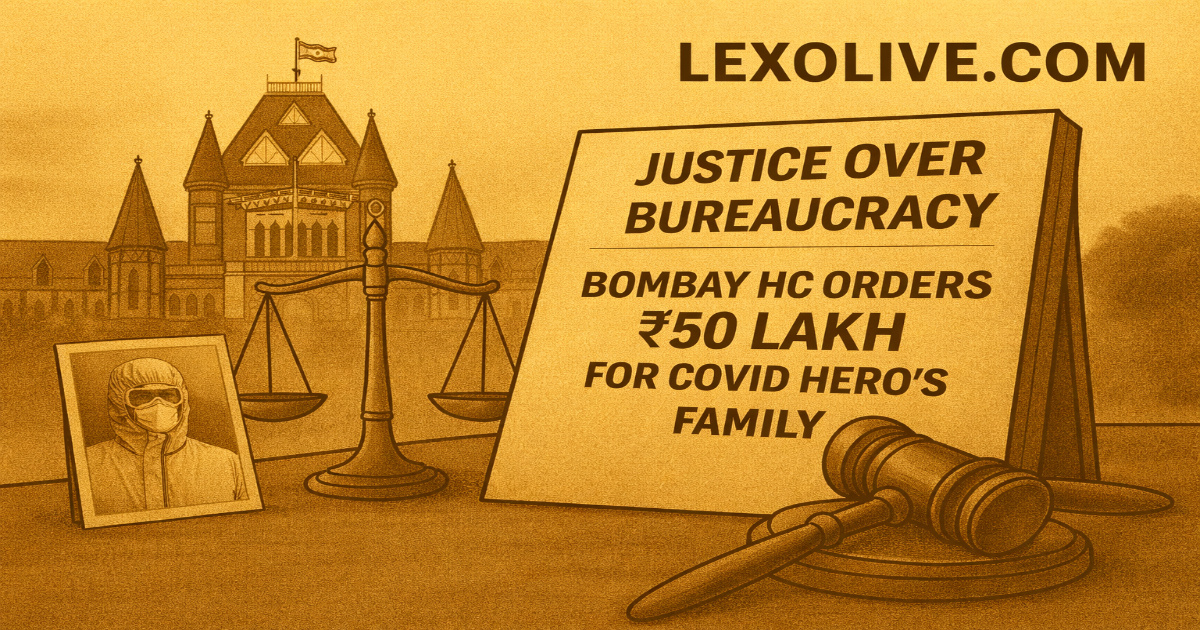
Justice Prevails: Bombay HC Orders ₹50 Lakh for COVID Hero’s Family
In a landmark judgment that underscores the primacy of substantive justice over administrative formalities, the Kolhapur Bench of the Bombay High Court has directed the Maharashtra state government to provide an ex-gratia insurance compensation of ₹50 lakh to the family of a deceased frontline worker. The ruling explicitly states that bureaucratic rigidity must not obscure the fundamental demands of justice, especially when recognizing the sacrifices made during the COVID-19 pandemic.
A Division Bench comprising Justices M. S. Karnik and Ajit B. Kadethankar delivered this significant verdict, which arose from a petition filed by the legal heirs of Yashwant Khandu Jadhav. Jadhav served as an Extension Officer with the Karveer Panchayat Samiti in Kolhapur and tragically succumbed to COVID-19 in July 2021 after contracting the virus while engaged in pandemic-related duties.
The petitioners, represented by advocate K. D. Indapurkar, sought the Court’s intervention to secure benefits under a Government Resolution (GR) issued on April 25, 2022. This GR established a ₹50 lakh insurance cover for the families of frontline workers who died after contracting COVID-19. The central point of contention was the resolution’s stipulation that the benefit was applicable only for deaths occurring on or before June 30, 2021. Yashwant Jadhav, having tested positive on June 16, 2021, and hospitalized thereafter, passed away on July 11, 2021, placing his case just outside the official cutoff date. Consequently, the state authorities had rejected the family’s claim.
Appearing for the state, Advocate V. M. Mali defended the government’s position, arguing that the establishment of a cutoff date was a necessary administrative measure. He contended that the GR’s terms were clear and that there was no legal infirmity in prescribing June 30, 2021, as the deadline for eligibility. This stance was supported by Advocate Kedar P. Lad, representing the Zilla Parishad, who maintained that the rejection of the proposal was correct as it fell outside the GR’s defined scope.
The High Court, however, firmly rejected these technical arguments, delivering a powerful rebuke to an overly rigid interpretation of the rules. The Bench emphasized that the denial of relief to individuals who died shortly after the cutoff date would violate core constitutional principles of justice, fairness, and human dignity. The judges articulated that such an approach would be antithetical to public conscience and the collective societal debt owed to frontline workers.
In a poignant reflection on the pandemic era, the Court memorialized the extraordinary contributions of frontline personnel. The judgment noted that amidst global crisis, these individuals demonstrated remarkable courage and unwavering dedication, transforming their professional duties into acts of profound selfless service. The Bench stressed that the state must view such cases through a humanitarian lens, aligning its actions with constitutional ethos that demands sensitivity towards citizens who have endured suffering. The Court unequivocally stated that procedural strictness must never be allowed to eclipse the pursuit of substantive justice.
A critical element of the Court’s reasoning focused on the timeline of Jadhav’s illness. The Bench observed that he had contracted the coronavirus well before the June 30 deadline and was continuously hospitalized until his death. Therefore, treating the cutoff date as an absolute and inviolable barrier was deemed unjust. The Court declared that this was a fitting case for the benevolent extension of the GR’s benefits, as the spirit of the scheme aimed to support those who lost their lives in the line of duty during the pandemic.
The ruling carries profound implications for the interpretation of government welfare schemes. It establishes a precedent that eligibility criteria, particularly cutoff dates in compassionate policies, should be applied flexibly and contextually. The judgment reinforces the idea that the overarching purpose of such schemes is to provide solace and support, not to create insurmountable procedural hurdles for grieving families. By prioritizing intent over literal interpretation, the Court has championed a more equitable and compassionate administrative philosophy.
Ultimately, the Bombay High Court directed the Maharashtra government to disburse the ₹50 lakh insurance amount to Yashwant Jadhav’s family within four weeks. The order concluded with a powerful assertion: denying relief in this circumstance would constitute a disservice to the sacrifice made by the deceased in the nation’s battle against the pandemic. This verdict stands as a robust judicial affirmation that the law must serve as an instrument of empathy and justice, particularly when honoring those who served on the front lines of a historic public health emergency. It sends a clear message to authorities that in balancing administrative convenience with human suffering, the scales of justice must invariably tilt toward compassion and substantive equity.
For the Petitioners- Advocate K. D. Indapurkar
For the Respondent State of Maharashtra– Advocate V. M. Mali
For the Respondent Zilla Parishad– Advocate Kedar P. Lad
Read more:-
One thought on “Justice Over Bureaucracy: Bombay HC Orders ₹50 Lakh for COVID Hero’s Family”