
Date: February 17, 2026
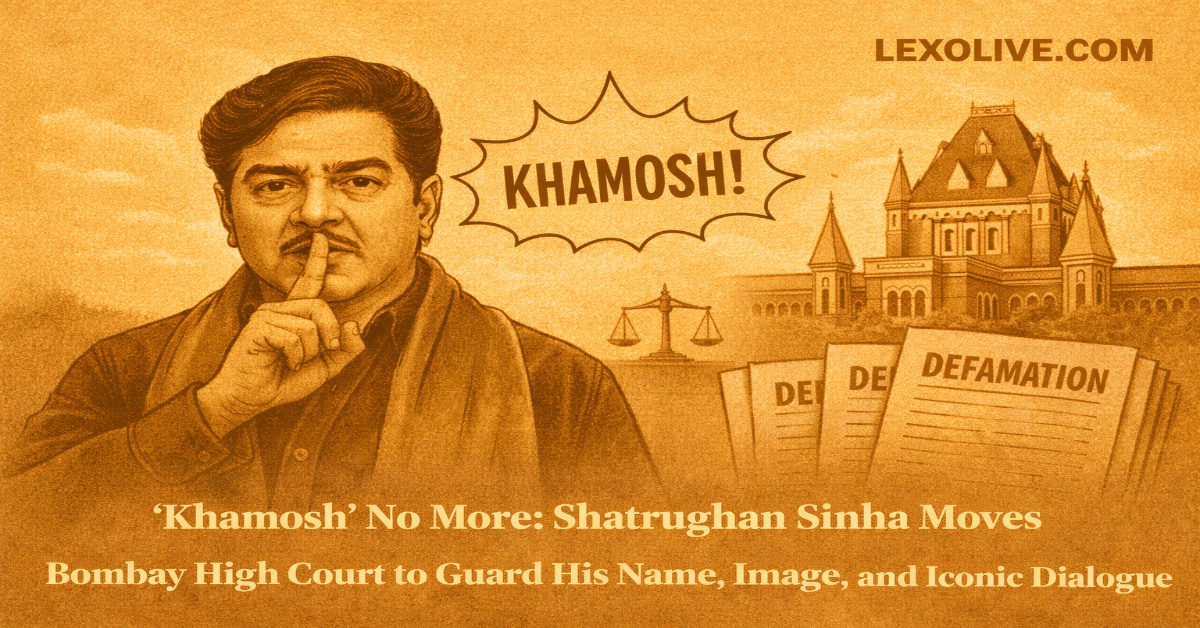
Mumbai: The word “Khamosh” —the iconic, thunderous dialogue delivery that has been synonymous with Shatrughan Sinha for decades—is now at the center of a significant legal battle. The veteran actor and politician has approached the Bombay High Court seeking to legally safeguard his “personality rights,” aiming to prevent the unauthorized commercial exploitation of his name, image, and most distinctively, his trademark dialogue delivery, particularly the famous utterance, “Khamosh.”
The plea, which underscores the cultural and commercial value associated with the actor’s decades-long career, was heard by a single bench of Justice Sharmila Deshmukh on Monday. After hearing the initial arguments presented by the actor’s legal team, the court reserved its order on the application for ad-interim relief.
The lawsuit, filed through his son Luv Sinha and represented by the law firm INDIALAW LLP, paints a picture of an artiste whose influence transcends the silver screen. The 83-year-old actor, known for his deep baritone and unique dialogue delivery, argues that his identity has been systematically misappropriated by various entities, including global tech giants and unknown online platforms.
The Essence of “The Shotgun” Persona
At the heart of Sinha’s legal battle is the claim that his persona is a unique blend of style, mannerism, and catchphrases that have become exclusively associated with him over a prolific career spanning more than four decades.
“The Plaintiff has a unique style of dialogue delivery and especially the unique manner of delivery of the term ‘Khamosh’ has been only associated with the Plaintiff,” the legal filing asserts. It further elaborates on his commanding screen presence, which earned him the iconic screen name ‘Shotgun’—a moniker that has stuck with him both in the film industry and in public life.
Sinha’s career, marked by memorable roles in classics like Kalicharan, Vishwanath, and Kala Patthar, has generated substantial goodwill and commercial value. The plea argues that this goodwill continues to benefit him, solidifying his status as a cultural icon whose identity carries significant economic weight.
The Grievance: Unauthorized Use and Digital Misrepresentation
The primary grievance in the suit targets the alleged misuse of his performances in the digital realm. Sinha has taken strong exception to the creation and dissemination of Graphic Interchange Formats (GIFs) and video clips that utilize snippets from his films without his consent.
According to the plaint, these actions amount to a distortion and mutilation of his performances. The actor contends that such unauthorized reproductions are not only a violation of his moral rights but are often presented in a manner that is prejudicial to his reputation.
“The Defendants are distorting, mutilating and / or making other modifications to the video recordings of his performances… The Defendants, by reproducing clips containing the Plaintiff’s performance, and that too in a manner which is prejudicial to the Plaintiff’s reputation, brings disrepute to the Plaintiff and makes him the subject of unsavoury humour, are violating his moral rights in his performances,” the plea states emphatically.
This argument highlights a growing concern among celebrities in the digital age: the ease with which their image and work can be repurposed, often losing context and potentially harming their public standing.
A Dual Career: Cinema and Politics
The petition also strategically highlights Sinha’s parallel career in public service to strengthen his claim for comprehensive personality rights. It notes that his influence is not limited to entertainment but extends significantly into the socio-political fabric of the country.
Having entered politics in 1992, Sinha has served as a Member of Parliament and a Union Cabinet Minister, holding key portfolios. The plea argues that this political journey has further enhanced his stature as a public figure whose name, image, and persona carry significant social, political, and cultural influence.
“Over the years, he has held key ministerial portfolios and contributed to policy-making and governance… His political journey, marked by widespread recognition and respect, has enabled him to successfully bridge the worlds of cinema and governance,” the document reads, emphasizing that the unauthorized use of his identity causes harm across all facets of his public life.
The Legal Argument: Preventing “Passing Off”
Beyond the violation of moral rights, Sinha’s legal team is building a case around the concept of “passing off”—a common law tort used to prevent one party from misrepresenting its goods or services as those of another. The plea argues that by using his name, image, and iconic dialogue without authorization, the defendants are creating a false association between themselves and the actor. This misrepresentation, the suit contends, is likely to deceive the public into believing that Sinha endorses their products, platforms, or content, thereby diluting the commercial value of his brand and diverting potential business opportunities away from him.
Seeking John Doe Orders and Targeting Tech Giants
In a move to cast a wide net against potential infringers, Sinha has not only named specific defendants but has also sought “John Doe” orders, which allow him to take action against unidentified parties who may violate his rights in the future. The list of named defendants in the lawsuit reads like a who’s who of the internet, including major technology and social media corporations such as Meta (which owns Facebook and Instagram), X (formerly Twitter), Google, Amazon, Pinterest, and Blogspot.com.
Additionally, the suit has impleaded the Ministry of Electronics and Information Technology and the Union Department of Telecommunication as parties, likely to ensure any subsequent court orders can be effectively enforced against online intermediaries.
Sinha’s legal team, led by Advocate Hiren Kamod, along with Advocates Nidhi Singh, Abha Shah, and Amisha Upadhyay, argued that the defendants’ actions are ongoing and cause irreversible harm to the actor’s reputation, goodwill, and commercial interests. They contend that this deprives him of the right to control the quality and authenticity of content associated with his persona, thereby establishing a clear cause of action.
As the court reserves its order on interim relief, the case marks another significant instance of Indian celebrities seeking to define and protect the boundaries of their digital and commercial identities in an era where their legacy can be easily digitized, shared, and sometimes, distorted.
Read more:-
One thought on ““Khamosh” No More: Shatrughan Sinha Moves Bombay High Court to Guard His Name, Image, and Iconic Dialogue”