
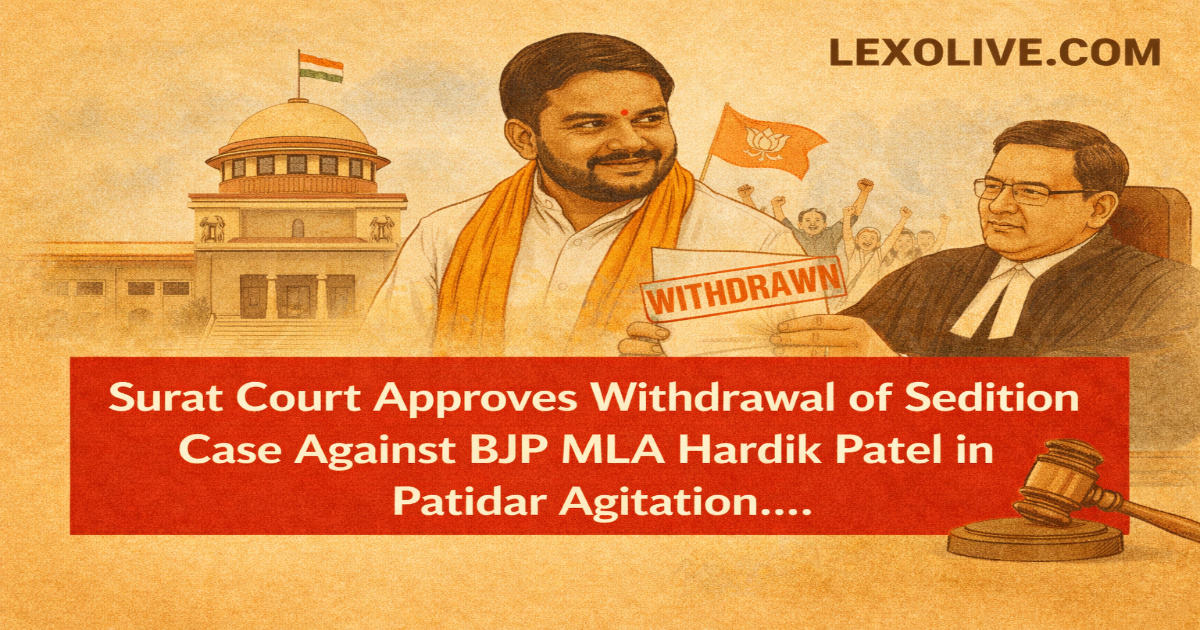
Surat Court Approves Withdrawal of Sedition Case Gives Big relief to BJP MLA Hardik Patel
Surat, Gujarat | December 18, 2025: In a significant legal and political development, a Surat court on Thursday permitted the Gujarat government to withdraw a longstanding sedition case against Bharatiya Janata Party (BJP) legislator Hardik Patel and three of his former associates. The case stemmed from the volatile 2015 Patidar reservation agitation that had shaken the state’s political landscape.
Surat Court Principal District and Sessions Judge R.A. Trivedi sanctioned the government’s application, effectively terminating the prosecution against the BJP MLA from Viramgam and his then-aides Alpesh Kathiria, Vipul Desai, and Chirag Desai. This marks the second major sedition case linked to the agitation to be withdrawn against Patel this year, following a similar decision by an Ahmedabad sessions court in March.
The Genesis of the Case
The roots of the case trace back to October 2015, at the peak of the Patidar Anamat Andolan Samiti (PAAS) movement. The agitation, led by a young Hardik Patel as its convener, demanded reservation for the Patidar community in government jobs and educational institutions under the Other Backward Classes (OBC) quota. The protests, which began as mass rallies, later spiralled into widespread violence across Gujarat.
The specific case in question was registered at Surat’s Amroli police station. It was based on an alleged speech where Hardik Patel was accused of making inflammatory remarks, purportedly instigating Patidar youth to “kill police personnel instead of committing suicide.” These statements led to charges under serious sections of the Indian Penal Code (IPC): Section 124-A (sedition), which carries a maximum penalty of life imprisonment, Section 115 (abetment of an offence punishable with death or life imprisonment), and Section 201 (causing disappearance of evidence).
A Journey from Agitation to Politics
The Surat court’s decision closes a chapter in Hardik Patel’s dramatic political evolution. From being the fiery face of a community agitation against the then-BJP state government, Patel transitioned into mainstream politics. He joined the Indian National Congress in 2019 and was appointed its Gujarat working president in 2020. In a notable political switch, he defected to the BJP in June 2022 and contested and won the state assembly election from the Viramgam constituency later that same year.
The withdrawal of this case is viewed through a political prism, given that the application was moved by the state government currently led by his new party. His defence lawyer, Yashwant Vala, clarified the legal basis, stating, “The state government had earlier issued a notification ordering the withdrawal of nearly 90 percent of cases related to the Patidar agitation, including sedition cases. The public prosecutor’s application was based on this notification.”
The Prosecution’s Original Case and the Agitation’s Aftermath
The police, in a chargesheet filed in 2016, had built a case alleging a pre-planned conspiracy. They accused Patel and his aides of systematically inciting the community’s youth to violence to coerce the government into accepting their quota demands. The chargesheet detailed how on August 25, 2015, after a massive rally in Ahmedabad, Patel was briefly detained at the GMDC ground. It alleged that PAAS leaders then deliberately circulated misleading messages about his “wrongful arrest,” triggering massive riots.
For nearly four days, Gujarat witnessed arson, stone-pelting, and large-scale damage to public property. The chargesheet quantified the devastation, stating that property worth approximately ₹40 crore was destroyed, 203 police personnel were injured, and police constable Dilip Rathva lost his life in Surat during the unrest.
It is noteworthy that Surat police had also initially invoked IPC Section 153-A (promoting enmity between different groups) against Patel. However, the Gujarat High Court had subsequently quashed this particular charge while upholding the more severe sedition charge, which has now been withdrawn.
Legal Context and Broader Implications
The Surat court’s approval aligns with the legal principle allowing the state, as the prosecuting authority, to withdraw from a prosecution with the court’s consent, as outlined under Section 321 of the Code of Criminal Procedure (CrPC). The judge’s decision signifies a judicial acceptance of the government’s reasoned application in this instance.
This development brings a legal reprieve to Hardik Patel, removing the shadow of a serious charge that had persisted for nearly a decade. For the other three accused, it also means closure from a protracted legal battle. Politically, it consolidates Patel’s position within the BJP fold, removing a potential vulnerability.
The withdrawal of sedition cases from the 2015 agitation period continues to be a subject of public discourse, with debates focusing on the nature of the charges, the right to protest, and the state’s discretionary power in ongoing prosecutions. The Surat court’s order, while concluding this specific case, leaves broader questions about the application of sedition law in the context of mass political movements open for continued legal and societal examination.
A Controversial Decision Amid National Debate on Sedition Law
The Surat court’s order arrives amidst an ongoing and heated national debate regarding the application of sedition laws in India. Legal experts and civil society groups have long argued that Section 124-A of the IPC is often misused to curb dissent and silence political opposition.
The withdrawal of this high-profile case, particularly after the accused’s induction into the ruling party, is likely to intensify this debate, with critics viewing it as a selective application of justice based on political convenience. Proponents of the government’s decision, however, are likely to frame it as a corrective measure to resolve cases stemming from a charged socio-political movement, in line with the state’s notification for a broad closure of agitation-related cases. This dichotomy ensures that the legal closure of the case will not necessarily translate into a closure of the contentious discussions surrounding it, keeping the Patidar agitation and its legal aftermath a point of reference in India’s political discourse.
The Role and Discretion of the Judiciary in the Matter
The Surat Court decision to permit the withdrawal underscores the discretionary power vested in trial courts under the CrPC when the state seeks to discontinue prosecution. In its ruling, the Surat Court examined the government’s application on its merits, ensuring the request was not manifestly oppressive or malicious. Ultimately, the Surat Court approval marks the final legal step in terminating a decade-old proceeding, highlighting the judiciary’s role as the gatekeeper in such processes, even as it acts on the executive’s plea. With this order, the Surat Court has formally severed the last major legal thread from the 2015 agitation for the accused. The proceedings in the Surat Court thus conclude, leaving the political and legal ramifications to be debated elsewhere.
Read more:-