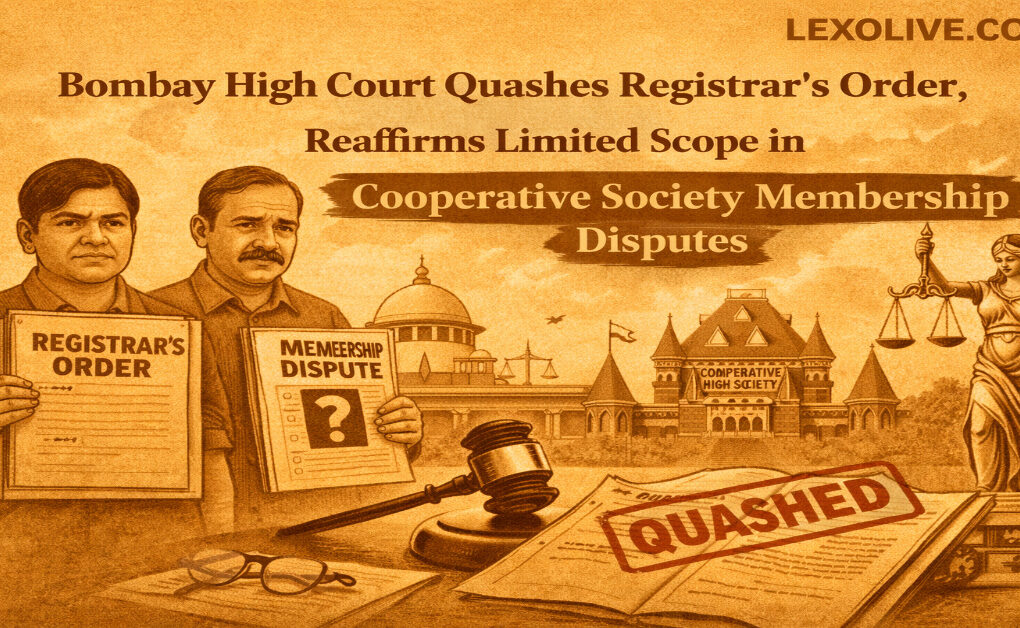
Mumbai: In a judgment clarifying the limits of quasi-judicial authorities under the Maharashtra Co-operative Societies Act, 1960, the Bombay High Court has underscored that such bodies are not empowered to adjudicate disputes related to inheritance or the validity of succession documents. The ruling came while quashing a revisional authority's decision that had denied membership to a man in a Peddar Road cooperative housing society over alleged discrepancies in a nomination form.
Justice Amit Borkar delivered the order on February 9, emphasising that the role of the cooperative department is strictly confined to regulating membership as per the Act and the society's byelaws, and cannot assume the functions of a civil court by delving into title disputes or the genuineness of succession claims.
The Genesis of the Dispute. The case involved a flat originally allotted to one Pravinkumar Dave's father, who in 1974 nominated his minor son for membership. The senior Dave passed away a year later, leaving ten legal heirs and no will. In 2002, Pravinkumar Dave approached the housing society seeking membership based on the 1974 nomination; when the society did not act, he approached the cooperative department, where the Deputy Registrar ruled in his favour in 2006 — a decision later reversed on revision by the Divisional Joint Registrar, which found “overwriting” in the 32-year-old nomination form and deemed it unreliable.
The Heirs' Stand. Dave's advocate, Satyavijay Vaishnav, informed the court that of the ten legal heirs, a clear majority had no objection to Dave's membership — six had issued formal No-Objection Certificates, one had predeceased the father, two raised no objection, and only a single heir opposed the claim. The society itself had not disputed Dave's eligibility under its byelaws.
Court's Observations. Citing a 2016 Supreme Court judgment, Justice Borkar noted that nomination does not confer ownership or absolute title — its purpose is functional, empowering the society to deal with an identified individual regarding a deceased member's share, while ultimate ownership is governed by succession law. Since Dave's father died intestate, his interest devolved on all Class I legal heirs under the Hindu Succession Act, and the record showed a clear majority of heirs supported Dave's claim.
On the question of who could challenge such orders, the court noted the order granting membership had not been challenged by the one dissenting heir, but by the housing society and a third party claiming tenancy rights. “A tenant has no locus standi to question the internal arrangement among legal heirs regarding membership of the society,” Justice Borkar held.
Conclusion. The court held the Divisional Joint Registrar had grossly exceeded its jurisdiction by scrutinising a 32-year-old document's authenticity in an exercise resembling a civil trial. “The authority under the Maharashtra Co-operative Societies Act is concerned with the regulation of membership, and it is not a civil court deciding succession disputes,” the court reiterated, quashing the Divisional Joint Registrar's order and restoring the Deputy Registrar's 2006 directive granting Dave membership.